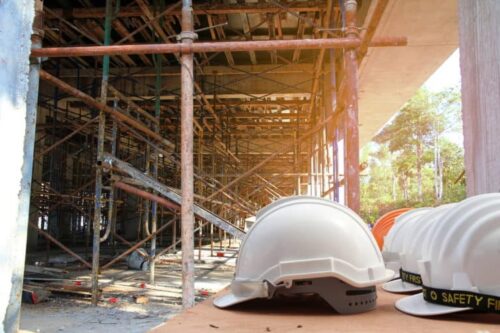
 Concrete formwork selection can impact structural integrity, surface finish quality, and cost efficiency in construction. Industrial concrete forms help ensure that poured concrete sets in the intended shape.
Plywood formwork is a high-strength, reusable engineered wood panel used as a mold for pouring concrete. It is used in concrete structures like walls, columns, and slabs thanks to renowned strength-to-weight ratios and design flexibility. Below, learn more about Baltic Birch plywood’s mechanical properties, face grades, and protective coatings for industrial concrete formwork applications.
Why Baltic Birch? Mechanical Properties and Load-Bearing Integrity
Formwork plywood needs to maintain strength and dimensional stability while withstanding impacts, pressure, and more. Baltic Birch performs well in these conditions due to its cross-banded construction, where each veneer layer runs perpendicular to the next. This structure improves strength and reduces warping or deflection during concrete pours.
Other mechanical characteristics and structural advantages include:
- Void-free core. Baltic Birch uses solid birch veneer in every ply, unlike conventional plywood that may contain gaps or softer interior layers.
- Bending strength. Baltic Birch plywood is known for supporting structural stability under load.
- High density and uniform structure. Allows contractors to specify tighter support spacing and improves load-bearing performance in industrial concrete formwork applications.
Achieving High-Quality Concrete Finishes
Baltic Birch formwork plywood treated with phenolic film coatings helps produce consistently smooth concrete surfaces. The phenolic layer resists highly alkaline concrete environments, preventing chemical interactions between wet concrete and the wood substrate that can lead to surface defects.
The resin-impregnated film creates a smooth barrier that reduces cement paste adhesion to the form. As a result, formwork stripping is cleaner and faster, reducing labor time on site while helping maintain uniform surface characteristics across panels. This can be especially important for architectural-grade concrete finishes for exposed applications.
Film-faced Baltic Birch plywood also resists moisture absorption, edge swelling, and surface wear, common failure points in lower-grade industrial formwork materials. With proper cleaning and maintenance between pours, panels can continue delivering high-quality concrete finishes across multiple cycles.
Formwork Plywood Thickness, Grades, and Other Specifications
Surface integrity also depends on plywood thickness and type. Selecting appropriate formwork plywood thickness will involve evaluating load conditions, support spacing, and durability demands, with custom dimensions supporting unique project requirements.
Factory-sealed edges prevent moisture ingress at panel perimeters and maintain dimensional stability when contractors reuse panels across multiple projects.
Contact Thomes North America to Learn More
Baltic Birch plywood addresses industrial concrete formwork challenges through superior mechanical properties, enhanced reusability, and consistent surface performance. Our phenolic-coated panels withstand concrete pressure while producing smooth finishes that reduce labor costs, and all of our Baltic Birth plywood materials comply with TSCA Title VI and CARB-2 regulations.
Contact us to discuss your project requirements and receive detailed specifications for our Baltic Birch formwork solutions.